← Back to homeRésumé

Nathaniel Mareano

Computer Information Systems student with experience in software development, analytics, solutions consulting, and public-sector technology. Work spans research and requirements through implementation, validation, presentation, and handoff.
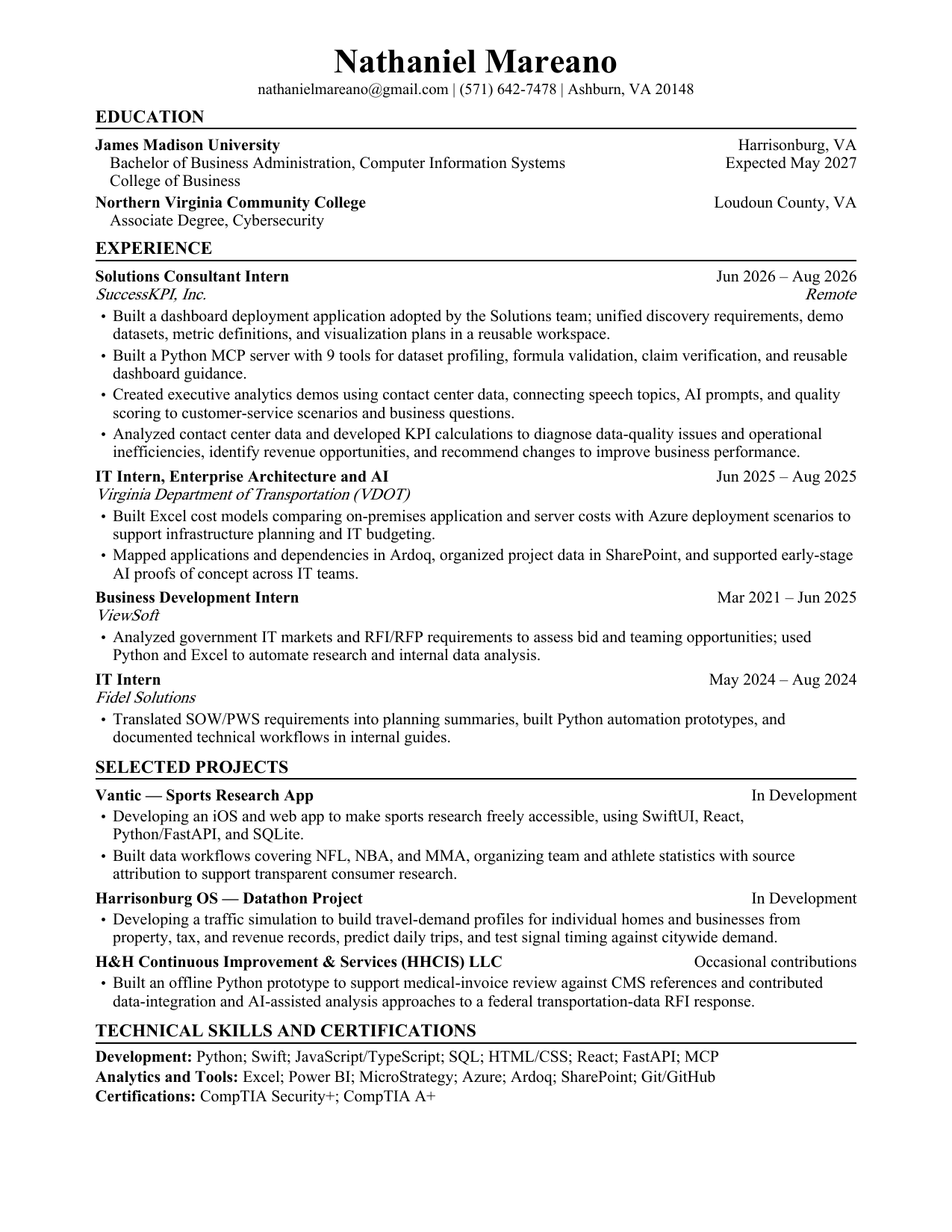
View original one-page résumé

The original layout, at a larger reading size.

Download PDF
Nathaniel Mareano’s original one-page résumé in its unchanged Harvard format. An expanded text version follows below.

Education

James Madison University

Bachelor of Business Administration, Computer Information Systems

College of Business

Northern Virginia Community College

Associate Degree, Cybersecurity

Experience

Solutions Consultant Intern

SuccessKPI, Inc.

  • Designed and built a dashboard-planning application adopted by the Solutions team; connected discovery requirements, demonstration datasets, metric definitions, calculations, visualization plans, and reusable guidance in one workspace.
  • Built a Python MCP server with nine tools for dataset profiling, formula validation, source-based claim verification, and dashboard guidance.
  • Created executive analytics demonstrations using contact-center data, speech topics, AI prompts, sentiment, and quality scoring to answer customer-service and business questions.
  • Developed KPI calculations to investigate data-quality issues and operational inefficiencies, identify revenue opportunities, and recommend changes. Contributed to first-contact-resolution analysis involving repeat contacts, escalations, quality scores, KPI tiles, and drilldowns.
  • Used Claude Code and Codex to support implementation, review, and testing while owning the application’s architecture, analytical logic, validation, and iteration with team feedback.
  • Prepared code, datasets, dashboard plans, metric build sheets, setup instructions, and handoff materials so the Solutions team could understand and continue the work.
Explore Greyline

IT Intern, Enterprise Architecture and AI

Virginia Department of Transportation

  • Built Excel cost models comparing on-premises application and server costs with Azure deployment scenarios to support infrastructure planning and IT budgeting.
  • Mapped applications and their dependencies in Ardoq and organized project data in SharePoint to support enterprise-architecture work.
  • Supported early-stage AI proofs of concept across IT teams.

Business Development Intern

ViewSoft

  • Researched government IT markets and analyzed requests for information and proposals (RFIs and RFPs) to assess bid and teaming opportunities.
  • Used Python and Excel to automate research and internal data analysis.

IT Intern

Fidel Solutions

  • Translated statements of work and performance work statements (SOWs and PWSs) into planning summaries.
  • Built Python automation prototypes and documented technical workflows in internal guides.

Selected projects & contributions

Vantic

Sports research application

  • Developing an iOS and web product to make sports research freely accessible, using SwiftUI, React, Python, FastAPI, and SQLite.
  • Built data workflows covering NFL, NBA, and MMA information, organizing team and athlete statistics with source attribution. The current working web prototype focuses on NFL research, with visible calculations, sample limits, and source freshness.
View the Vantic walkthrough

Harrisonburg OS

City-data and simulation project

  • Developing a city-scale data and simulation prototype for Harrisonburg, connecting public geography, traffic-volume records, and aggregate population inputs.
  • Built an interactive map, source registry, and intersection inspector to make observed data and modeled movement inspectable. The next stage is to validate network behavior and connect vehicle movement to signal logic before comparing traffic strategies.
View the Harrisonburg OS walkthrough

H&H Continuous Improvement & Services LLC

Project contributions

  • Built CSM, an offline Python prototype for medical-invoice reference review, with local data management, searchable results, and evidence connecting procedure and diagnosis pairs to applicable CMS Article versions.
  • Packaged and tested a native desktop workflow with review history and exports using synthetic invoice data. The application supports reference screening and human review.
  • Contributed data-integration and AI-assisted analysis approaches to a federal transportation-data RFI response.
View the CSM walkthrough

Technical skills & certifications

Development
Python; Swift and SwiftUI; JavaScript and TypeScript; SQL; HTML and CSS; React; FastAPI; SQLite; APIs and data integration; Git and GitHub.
Analytics and enterprise tools
Excel; Power BI; MicroStrategy; Azure; Ardoq; SharePoint; contact-center analytics; KPI design; dataset profiling; formula validation; data-quality investigation.
AI-assisted development
Claude Code; Codex; Model Context Protocol (MCP); prompt and context design; tool calling; source verification; human review of model-assisted work.
Business and delivery
Requirements analysis; government-market research; RFI and RFP analysis; SOW and PWS interpretation; technical documentation; analytics presentations; application testing and handoff.

Certifications

  • CompTIA Security+
  • CompTIA A+

Collaboration & working style

Collaboration and ownership

After a two-week platform boot camp at SuccessKPI, arranged meetings, sought context, and identified workflow gaps while managing an independent development schedule. Used team and mentor feedback to guide iteration.

Communication and analytical reasoning

Focused on how someone would interpret a result, including the definitions, assumptions, and drilldowns behind a KPI.

Learning and adaptability

Learned MicroStrategy by connecting new platform concepts with prior Power BI and SQL experience. Applied that learning directly to analytics demonstrations and dashboard preparation.

Creative problem solving

Used sketches and a physical prototype in a UNST 300 design-thinking exercise to explore an early idea. Reflected on how sharing unfinished ideas and helping across teams can make people more willing to contribute.

Judgment and usability

Approaches data and AI as tools that require context and verification. Focuses on choosing the right question, checking the supporting evidence, and making the resulting workflow understandable to the person using it.

Back to top ↑Explore the project walkthroughs